Iceland
Land of fire and ice.
366425
103000 KM²
REYKJAVÍK
Population
Country Size
Capital
Interesting Facts
Did you know that Iceland is the largest volcanic island in the world, its inhabitants believe in trolls and elves, and the Icelandic police has their own Instagram account?
Moreover, Icelandic is one of the oldest languages in Europe that is still spoken.
Iceland is the least populated country in Europe, with more sheep than people living there.
Reykjavík is the northernmost capital of the world.
Best travel time
In fact, the climate in Iceland is generally milder than the name suggests. This is mainly due to the Gulf Stream, which flows past Iceland and brings warm currents from the Caribbean. At the same time, it also means that this mild air mixes with the cold air from the Arctic, which results in many and frequent weather changes.
In Iceland there is this saying: "If you don't like the weather, wait 5 minutes." This contains a lot of truth, as I was able to discover on my trip to Iceland. Often you have all weather conditions and seasons on one and the same day.
For most "normal" tourists, the best time to travel is probably the summer months of June - August, which have less rainfall and are warm at the same time. At this time of year there is also still light even at midnight, since the sun never completely sets in midsummer. Especially for photographers, however, the winter months from October-March are also very attractive.
I have been to Iceland in March, which can still be called a winter month there. It is quite possible that there is still snow also in April. Especially the months of October and February / March are particularly good to watch northern lights. In addition, you already have more daylight than in November or December.
My experiences
Since I've covered my Iceland trip in detail on my blog, I'll just give a general overview of my travel experiences here. If you are interested in the details of the individual excursions, please feel free to visit my Blog .
First, I would like to mention that my trip took place during the Corona pandemic, which made it both more difficult and more unique.
At that time, we had to take several Corona tests both before departure in Germany and upon entry into Iceland, as well as enter a 5-day domestic quarantine immediately after arrival. During this time, one was not allowed to go shopping or to other busy places. Smaller walks off the main paths, however, were allowed. We therefore did not find the quarantine very bad. Actually, this trip had already been planned one year earlier in March 2020. At that time we unfortunately had to cancel it because of the first lockdown in Germany.
When our "time of freedom" in Iceland began, we quickly realized that all the effort and difficult conditions had been worth it. The island was as empty as it probably ever was or last was many decades ago.
Since our originally planned travel time of 12 days was now shortened to one week due to the quarantine, we unfortunately had far too little time on this beautiful island. Iceland is actually much bigger than I expected it to be. If you want to explore the whole island in one trip, I think you need at least three to four weeks if you don't want it to turn into stress. So we only had the opportunity to get to know a small part, mainly the south of the country. There are also many of the most famous "sights". And at exactly these places, where usually busloads of people arrive, we were mostly the only car on a large, empty parking lot.
We quickly realized: traveling in Corona times definitely has its advantages.
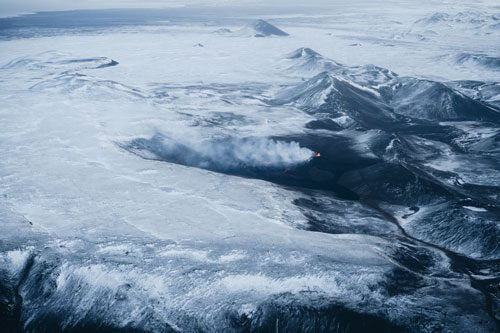
In addition to our pre-planned excursions, we were surprised by an experience of a very special kind. Shortly after our arrival in Iceland, the Fagradalsfjall volcano erupted on the Reykjanes Peninsula, south of the capital. Of course, we did not miss this opportunity and hiked to the site. Standing on the edge of a volcano that has just erupted is an undescribable experience that I will never forget. If you want to know more about our volcano expedition, you are welcome to read my blog post about it. blog post about it.
The Icelanders themselves are typically Scandinavian, rather reserved at first, but by no means dismissive, rather friendly and helpful.
The cost of living in Iceland is quite high, prices for food at least as in the more expensive supermarkets in Germany, rather a little higher. Actually, we had planned to eat little or not at all in restaurants, since the prices here are also significantly higher than in Germany. However, since at home we had still a lockdown and all restaurants were closed, we enjoyed the public life in restaurants and bars in Reykjavík even more. A beer costs here about € 8, a pizza about € 15-20.
I was also shocked by the prices for a rental car. I knew that everything is a bit more expensive in Iceland, but as we were traveling in winter we furthermore needed a four-wheel drive vehicle, which was finally over € 100 / day.
The price of accommodation is something for everyone, depending on how much comfort and luxury you want ... or not. We had booked two really nice cottages via Airbnb, which were also not cheap, but compared to hotel accommodation still reasonably affordable.
My favorite places
In Iceland, it is actually beautiful everywhere. No matter where you go, you always want to stop along the way to admire the breathtaking nature. Nevertheless, I have tried to select a few particularly beautiful places that you should not miss on your trip to Iceland.
Seljalandsfoss
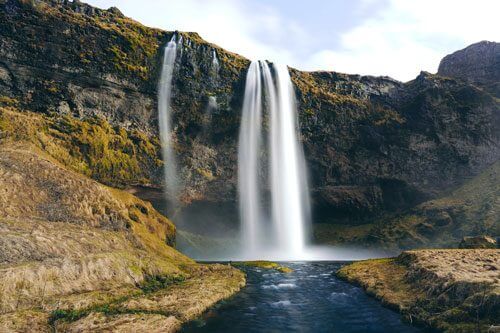
Seljalandsfoss is one of numerous waterfalls in South Iceland. It is about 60m high and springs from the famous Eyjafjallajökull volcano, which last erupted in 2010 and paralyzed large parts of the European air traffic.
A special characteristic of Seljalandsfoss is that you can walk behind the waterfall and see the thundering masses of water from a completely different perspective. But beware: here you get very wet!
It's also worth making a stop at the smaller and less known waterfall Gljúfrabúifoss, which can be found in a cave just a short distance from Seljalandsfoss.
Volcano Fagradalsfjall
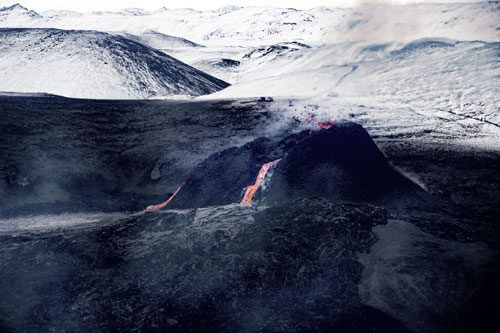
The luck to be able to do this excursion, you have of course not always. Nevertheless, the hike to the volcano Fagradalsfjall was for me the highlight of my Iceland trip.
There is still volcanic activity there, and other volcanoes could of course offer the chance for such a unique experience in the future.
So if you ever get the chance to witness a volcanic eruption (from a safe distance, of course), I can only recommend being there.
I will never forget this experience.
Diamond Beach
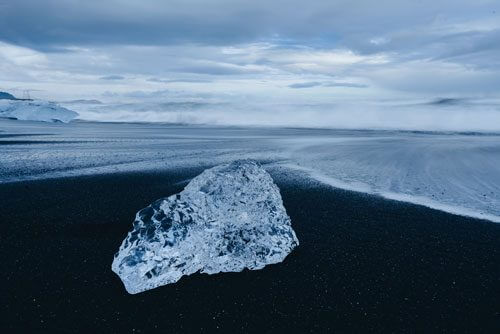
Diamond Beach is located in the southeast of the island, next to the glacier lagoon Jökulsarlon.
It got its name because of the ice blocks that drift out of the glacial lagoon to the open sea, where they wash up again on the black volcanic beach.
The small and larger icebergs have the most diverse shapes and glitter in the sun like true diamonds, which gave the beach its name.
You can also combine the visit there with an ice cave tour inside the glacier.
Black Beach of Vík
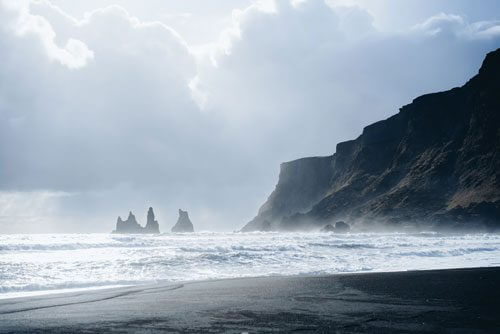
The black beach of Vík, located in the same named village Vík y Mýrdal on the south coast of Iceland, is characterized by black sandy beaches and the prominent basalt rocks rising from the sea.
Attention: the current here can be very dangerous and unpredictable, so you should not swim here or get too close to the shore.
 English
  German